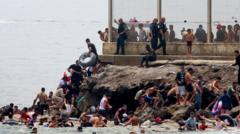
Unprecedented Migrant Crossing to Spanish Ceuta
A significant surge of migrants have successfully swum from Morocco to reach the Spanish enclave of Ceuta in a dramatic display of determination crossing international waters. This substantial influx of migrants swim across the strategic Mediterranean passage, highlighting the ongoing tensions at one of Europe's most contested territorial borders. The crossing represents one of the most visible migration events at this critical juncture.
Local Resources Stretched Beyond Capacity
The territory's administrative leadership has expressed grave concern regarding the strain placed on essential services and infrastructure. Officials report that the migrants swim operation has created immediate challenges for housing, medical facilities, and social services. Local authorities emphasize that current capacity levels were not designed to accommodate such rapid population increases, creating humanitarian and logistical complications that require immediate attention.
Healthcare systems, emergency response teams, and temporary accommodation facilities have reported being overwhelmed by the sheer volume of new arrivals requiring immediate assistance. Border personnel have worked continuously to process individuals and conduct necessary security screenings, but resources allocated to these operations remain insufficient for the current demand level.
Government Intervention Called for Urgently
Territory leadership has made an urgent appeal to the Spanish government for direct intervention and support. Officials stress that local administrations cannot sustainably manage this migration pressure independently and require comprehensive federal assistance. The request encompasses financial resources, personnel deployment, and strategic policy coordination to address the root causes and immediate consequences of these crossing patterns.
This appeal underscores the broader tension between local autonomy and national responsibility in managing migration challenges. The territorial government argues that decisions made at national and international levels directly impact their capacity to provide adequate services to both resident populations and newly arrived migrants.
Strategic Importance of the Ceuta Corridor
The Spanish enclave of Ceuta remains one of Europe's most strategically significant and geographically constrained entry points. Located on the African continent but governed by Spain, Ceuta serves as a natural crossing point for individuals seeking to reach European territories. The relatively short distance across the water makes it an attractive route despite the considerable dangers involved in swimming across open water.
The persistence of migration attempts through this corridor reflects the continued pressure of global displacement crises and economic disparities between North Africa and Europe. Ceuta's unique status as a European territory on African soil creates complex legal and administrative challenges that distinguish it from standard international border crossings.
Broader Migration Crisis Context
These recent events represent another chapter in the ongoing migration narrative affecting the Mediterranean region and European borders. Demographic pressures, political instability, and economic hardship in source countries continue to drive individuals toward European territories. The migrants swim incident demonstrates how geography, international borders, and human aspiration intersect at specific chokepoints worldwide.
Spanish authorities and European Union officials have long recognized that addressing migration requires comprehensive approaches encompassing border security, humanitarian assistance, and international cooperation with neighboring nations. The situation in Ceuta exemplifies the practical difficulties of implementing such multifaceted strategies at contested territorial boundaries.
Next Steps and Future Outlook
The immediate priority for territorial administration involves processing and caring for the newly arrived migrants while simultaneously reinforcing border security measures. Long-term solutions will require coordination between Spanish government agencies, European Union institutions, and North African nations to develop sustainable migration management frameworks.
Territory officials indicate that without substantive intervention from national authorities, similar crossing attempts will likely continue, potentially resulting in greater strain on already stretched resources. The call for government action represents both a humanitarian plea and a practical necessity for maintaining social stability and adequate service provision within the enclave.